Building VectorFlow, Part 2: Nobody Told Me the Job Was Marketing
Part two of a series on building VectorFlow. Part one covers where the idea came from.
I spent my twenties wanting to be an entrepreneur, and I built my career backwards from that.
I started with a computer science degree and entered a few entrepreneurship competitions in college. They didn’t go anywhere, which is fine. I still learned a lot from them.
Engineering came first, so I would know how to build a solution once someone handed me a defined problem. Product management came after, so I would know how to find the problem myself, how to decide whether it was worth building at all, and which parts of it to build.
That is good preparation for building a product. It is almost no preparation for getting anyone to use one.
What product management does not cover
Product management and marketing start from the same foundation: your users.
They do different things with it. Product works to understand those users’ problems deeply enough to advocate for them. Marketing works to identify those users and reach them.
Reaching them is only half of it. Someone who reads your post and scrolls on is still passive, and the message has to make the action you want more compelling than closing the tab. That action is what moves whatever number currently defines success.
Mine was signups.
Signups were never the point on their own. The solution in my head was going to change, and the only way to find out how was to put it in front of people and listen. That takes users, and getting users starts with a list. So signups became the number, and everything else got measured against it.
Who I was building for
My users were AI engineers, and their circumstances shaped everything.
They were usually on small teams and working against time constraints. Hand-building a data pipeline for a retrieval system takes months, and most of those months go to experimentation, since getting high quality data into a vector database means trying things and checking what comes back. Spending that long was not realistic for them. They needed a faster loop.
They were not executives. I had those conversations too, and they went nowhere.
A lot of executive buyers in this space are chasing solutions to problems they have not identified yet, or to problems not painful enough to justify the purchase. The market also moves fast enough that whatever they evaluated last quarter has already been replaced. Either way, they were not the ones building the thing, so they were never going to feel the pain I was solving. Their teams felt it.
Knowing that changed where I looked. Engineers who had already built three prototypes and lost weeks to parsing were the people who would recognize the problem in a sentence.
Picking a channel
Once you know who, you have to work out where, and every channel has a cost.
YouTube and TikTok were out for the same reason. I could make videos, but I would still need a way to get anyone to watch them, which puts me back at the distribution problem I was trying to solve. The founders I have seen win on those platforms mostly won by going viral, and that is not something you can plan. It is spontaneous, and it is luck.
LinkedIn was more plausible, since I could just post. But a lot of the people who follow me there fit the executive buyer persona rather than the AI engineer in the weeds, which was the one I needed. It never became a viable channel. Bluesky did not have the population to matter.
Reddit was where these engineers actually were, in numbers, already complaining about the exact problem.
A thousand dollars on Reddit ads
There are two ways to reach anyone on a channel: organic and paid. I tried both.
I put close to a thousand dollars into Reddit ads. Somewhere between three and five percent of signups came from them.
It was a colossal waste of money.
Developers do not want to be sold to
The organic side started badly. I made a list of forty or fifty subreddits and most of them turned out to be useless, which I expected. What I did not expect was how fast you get punished for trying.
Reddit is large enough that both the platform and its communities know they are targets for distribution. The default posture toward anyone promoting something is cynicism, and often hostility. The moment you try to funnel people to your product you get banned, or you earn a reputation that makes every future post worthless. I learned that one very quickly.
Some of that hostility is earned by the rest of us. A lot of people selling AI products do not understand the space they are selling into, so developers get pitched solutions to problems they do not have, at volume. By the time you show up, they have seen a hundred of you.
So the approach could not be selling. It had to be walking alongside a developer through their problem and leading them toward value, rather than pushing them somewhere they would reject on sight. Understand what they are complaining about, talk through strategies that would work whether or not they ever touch your product, and let trust build from there. You become someone people come back to, and only then does your solution look viable.
That worked better than anything else I did. I am still getting Reddit messages from posts I wrote months ago, people asking for help with OCR on a scanned PDF or where to start with parsing. Even while I was shutting VectorFlow down, people were trying to book time with me.
Peru
It stopped being sustainable while I was in Peru.
Six hours of sleep. Two hours on commuting and eating. Four hours of Spanish class. Everything left over went to Reddit or to building, and there was never enough of it for both.
A guy staying at my host family’s house ran a business automating operations for brick-and-mortar companies. I was complaining to him about the hours. There were not enough of them in a day, and part of what I was losing was the reason I came to Peru in the first place.
He asked why I had not automated it.
My first reaction was to feel insulted. My second, a few seconds later, was realizing he was right.
RedditFlow
By then I knew the shape of the problem. About five subreddits paid off consistently. Another fifteen or so produced the occasional nugget. Call it twenty communities where my users lived, and most of what got posted in them was irrelevant.
Timing mattered more than I expected. You have to be among the first to reply or your comment gets buried, and buried comments only surface months later when someone runs a keyword search.
There is a limit to that, though. If you are the first comment on every thread, including all the ones that never generate any engagement, it becomes obvious. People notice the guy who is everywhere. So you are balancing two things at once: being early enough to matter, and being restrained enough not to read as a spammer. Miss the timing and a thread takes off without you. Overdo it and you burn the reputation you spent months building.
So I wrote a command line tool to do it with me.
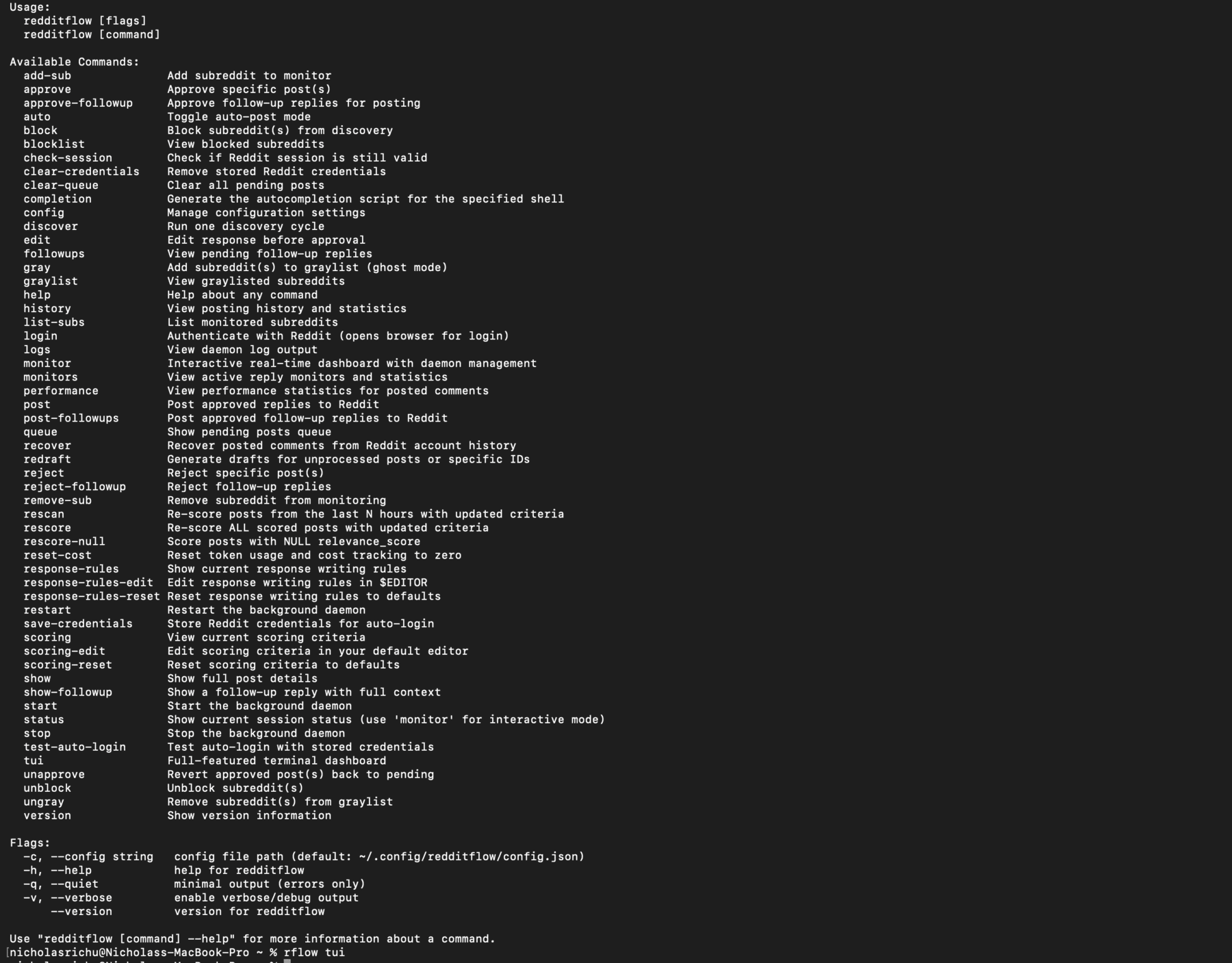
It scans the subreddits I have added, rates every post in a window from 1 to 10 on how closely it maps to a problem VectorFlow solved, and drafts a customized reply for the ones that score high. Everything lands in a queue I approve, edit, or reject.
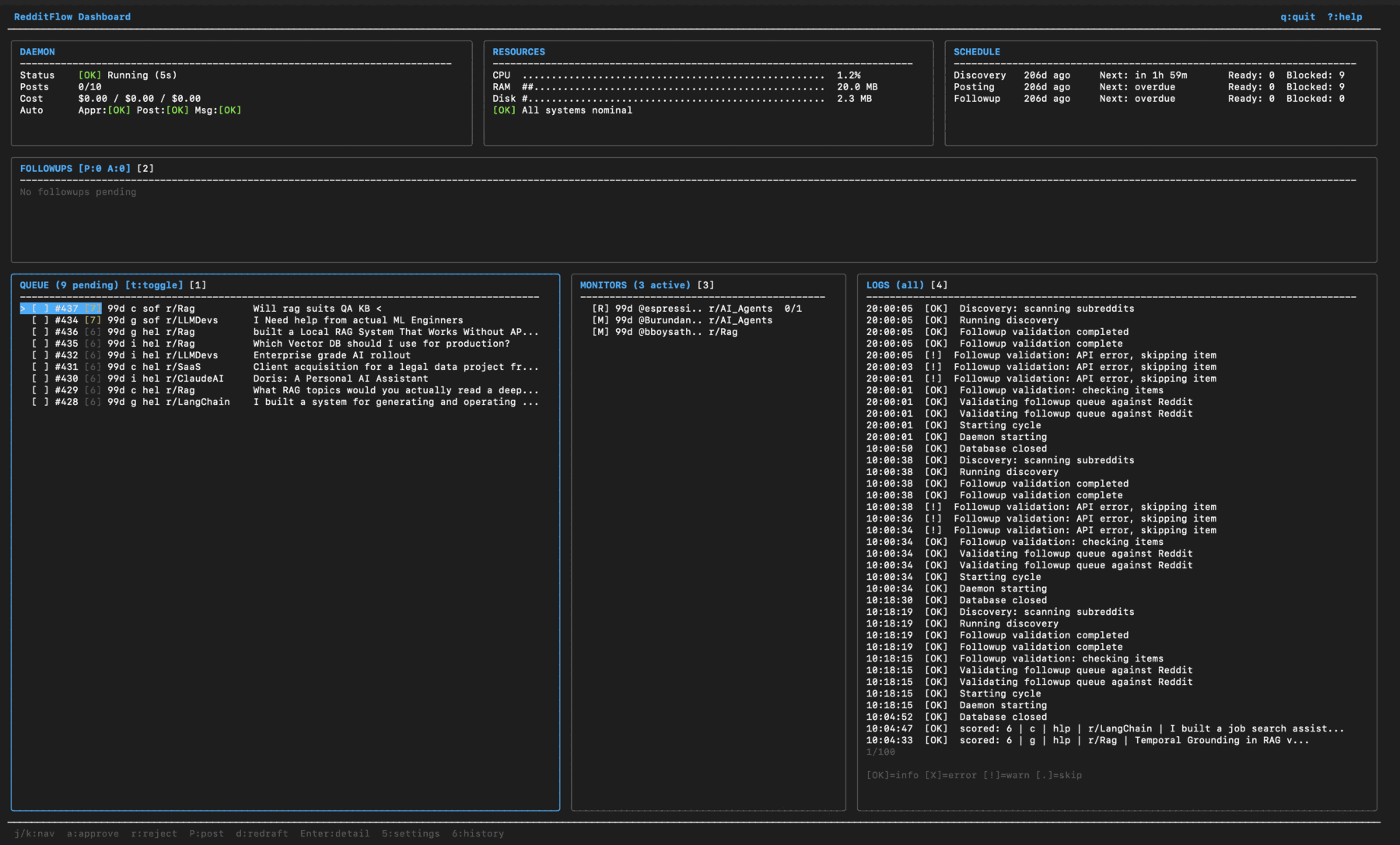
Click either screenshot to view full size.
I take the customized draft and modify it as much as it needs. Nobody wants a bot posting on their behalf, and a generated comment written without any care for how it reads will read like exactly that. The tool gave me an assist, mostly on triage.
That took go-to-market down to about three hours a day and left eight for building. That was a ratio I could deal with.
Once it was running, the threads sorted into two kinds of people. Some already understood what problems existed as they tried to build a solution, and knew what they were solving for. Others needed a lot more handholding. They knew they needed a working RAG and knew they needed a parser, and that was roughly where their knowledge ended.
That split is part of what led to VectorFlow’s chat-as-builder interface. It also raised the question I spent a long time on. How many people sat in each group, and which of them would actually pull out a credit card?
Instrumentation
I had no way to answer that without measuring it.
I instrumented everything. UTM attributes on every link, so a click could be traced back to a specific post in a specific subreddit, with a funnel built on top of it in PostHog. (PostHog is bloated and clunky, and it delivers a lot of value once you point it at a specific problem.)
I wanted to know where people fell out. Which days produced engagement, and whether people were upvoting, commenting, or asking follow-up questions. Whether they clicked the first link or only after a few exchanges. Once they landed, how long they stayed, how far they scrolled, whether they looked at pricing, and how many steps stood between arriving and signing up.
Some of that paid for itself immediately. Engagement clustered on certain days, so I turned RedditFlow off on the quiet ones and stopped burning tokens scanning an empty room.
Most of it went into rewriting the site. The landing page that is up now is roughly the twelfth version since December 2025, and the about page went through six or seven of its own. Every one of those came out of the funnel telling me where people were losing interest.
I cannot overstate this part. Messaging is pointless if you cannot track how effective it is across a funnel.
The experiment that broke my own rule
Ninety-five to ninety-seven percent of VectorFlow signups came from organic Reddit. I said the ads were a waste and I meant it.
Then I tested a potential pivot and got the opposite result.
I wanted to know whether VectorFlow would land if it were repackaged for legal, so I built separate landing pages that funneled into a version of the about page written in more legal-friendly language. Roughly ninety-five percent of the people who reached that page came from ads. Organic posting was actively a hurdle with that audience.
My first assumption was misclicks. Old phones, intrusive placement, fat fingers. So I narrowed the targeting to North America, then to iPhone users, then to desktop. It made no difference. I watched session replays and the visits were short but clearly deliberate.
The funnel simply stopped there. Almost nobody clicked past the landing page, and almost nobody signed up.
A rule that holds for one audience does not carry to the next. Ads were close to worthless for AI engineers and they were the only thing that reached lawyers, and in neither case did the channel finish the job. You still need a message that lands, a problem painful enough that someone will pay to make it go away, and people arriving who can actually make that purchase.
That last one is where legal broke. I was targeting firms with roughly fifty to two hundred lawyers. Larger than that and access gets difficult, with established competition already sitting in the account. Smaller than that, and solo practitioners have all the authority they need by virtue of being on their own, but they are extremely cost sensitive and averse to buying much of anything. The people landing on my page were in the segment I wanted, and they were not the ones who decide.
AI engineers could simply buy the tool. No executive approval, no procurement, a bottom-up motion the whole way. Legal was never going to work like that.
I would not have learned any of it from interviews alone, or from instrumentation alone. Qualitative data tells you what people say they need. Quantitative data tells you what they actually do. You need both before the picture makes sense.
What I would tell myself
Marketing and sales are badly underrated skills for an entrepreneur.
You can build an excellent solution to a genuinely taxing problem, and if you are bad at distribution you will fail. You can build a mediocre solution to that same problem, and with excellent distribution you will succeed. Product management alone does not get you there, and it was a much smaller part of the story than I expected going in.
Coming from product management, that reads as obvious. Living it is different. I could write a requirements doc in my sleep. I could not, at the start, write a Reddit comment that someone with the exact problem I solved would care about.
I got better at it. It took a lot longer than learning to build.
There was one more thing all that listening gave me. Walking developers through their problems for months meant hearing hundreds of them describe where their pipelines broke, and those conversations kept converging on the same place. Long before anyone worried about retrieval quality or chunking strategy, they were stuck on parsing.
That is where the next post starts.
← Back to Home